Grove Transport Economics
Consulting on Transport Issues, Projects, Programs and Opportunities
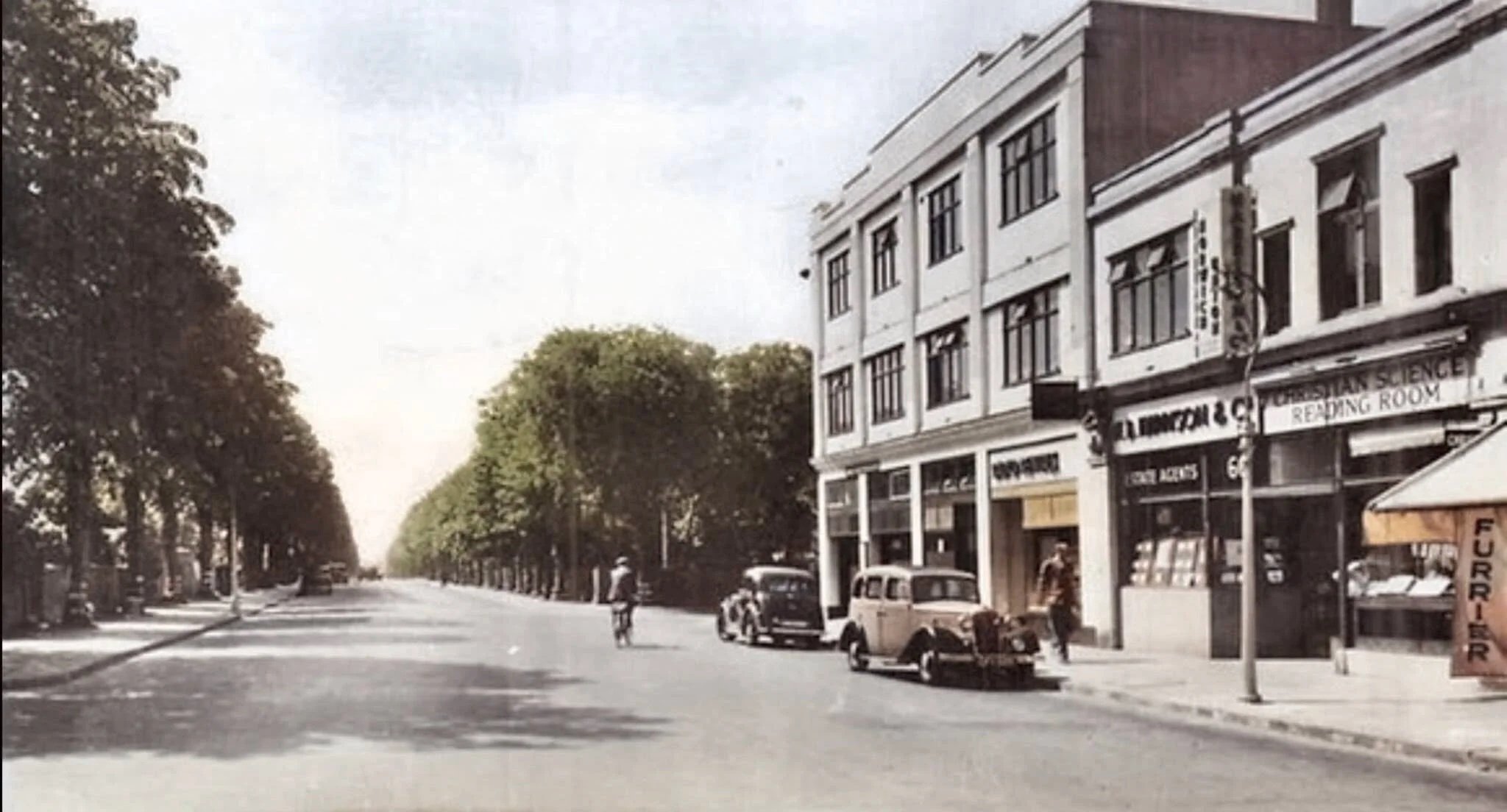
Grove Road Sutton Surrey UK, viewed from the town end, around 1928About
Grove Transport Economics
At Grove, we combine transport economic analysis, policy understanding, a multi-modal knowledge base and research strength to advise on complex transport issues, projects, programs and opportunities. We also collaborate, to assemble the range of capabilities each assignment calls for.
Director Phil Potterton is former head of the Bureau of Infrastructure, Transport and Research Economics, in a 30-year Commonwealth and Northern Territory public service career. Phil has been co-director of advisory firm Economic Connections, alongside Dr Anthony Ockwell. Phil was previously also the Canberra Strategy & Economics Lead at professional services firm GHD. At the 44th Australasian Transport Research Forum in 2023, Phil was awarded the John H Taplin Best Paper Prize for his paper: What policy rationales can underpin high speed, fast and improved passenger rail in Australia?
Grove Transport Economics’ service offering spans:
Cost-benefit analysis
Safety and emissions analysis
Policy and strategy development
Transport mode and service analysis

Services and Experience
-
Phil authored the Department of Finance’s 1991 Handbook of Cost-Benefit Analysis. According to the Handbook, Cost-benefit analysis is a method for organising information to aid decisions about the allocation of resources. Its power as an analytical tool rests in two main features: costs and benefits are each as far as possible expressed in financial terms and hence are directly comparable with one another; and costs and benefits are valued in terms of the claims they make on and the gains they provide to the economy as a whole, so the perspective is a ‘global’ one rather than that of any particular individual, organisation or group.[1]
Cost-benefit analysis methodology evolves with new learnings, technologies, problems and opportunities, while the core principles remain unchanged. In the early 2010s, Phil led the consultancy to scope a refresh of the National Guidelines for Transport System Management, which have become today’s Australian Transport Assessment and Planning (ATAP) guidelines.
For the former National Faster Rail Agency, Phil and Anthony Ockwell undertook-an examination of opportunities to refine and enhance the project evaluation framework as it relates to ‘transformative’ transport infrastructure initiatives and notably faster passenger rail. These included adding distance-related values of travel time savings and a dependent development wider economic benefit to the appraisal toolkit, as well as updating, in a downward direction, the recommended project discount rate and aligning the appraisal period with a project’s asset cost-weighted length of life. The report was published on the agency’s website.
Phil’s research paper, ‘Estimating net benefits of high speed rail: How fit for purpose is Australia’s economic appraisal guidance?’ for the 2025 Australasian Transport Research Forum (see Publications) revisits and extends the ideas and recommendations in the earlier project in the context of high speed rail evaluation.
Consulting applications of cost-benefit analysis methods include: a CBA of the impact of a possible change to current export permit arrangements which favour domestic processing capacity for hazardous waste destined for recovery; evaluating a NSW regional city multi-level car park proposal; and a CBA of capacity expansion and grade separation proposal for a section of Queensland’s Bruce Highway.
[1] See here for a revised 2006 edition of the handbook which retains these sentences and most of the original content.
-
Externalities, the spillover costs that impact third parties without compensation and the spillover benefits for which recipients do not have to pay, are integral to transport economic analysis. Road trauma, the public health consequences of transport pollution and adverse transport-related climate change all involve negative externalities, the understanding and analysis of which is key to our policy-oriented service offer.
Phil and Anthony Ockwell analysed the economic cost of road trauma in Australia for the 2015 year, for the Australian Automobile Association and including, innovatively, the annual budget cost to government. See at link here.
Partnering with Pekol Traffic and Transport and the Monash University Accident Research Centre, Phil and Anthony the emission and safety-related benefits of scenarios for a reduced age of Australia’s passenger vehicle fleet. See report at link here.
Also with Pekol Traffic and Transport, Phil identified, modelled and costed 25 possible initiatives to reduce the carbon emissions profile of the Queensland transport sector, including electric vehicle incentives, area congestion charging, parking levies and active transport.
-
Policy and strategy documents play a role in developing new directions, in bringing together the needed specialist inputs and in informing both stakeholders and the wider public.
Phil developed a draft Australian Capital Territory freight strategy, addressing network, last mile access, data, regional linkage and other issues (see at link here)
Phil prepared an industry profile of dangerous goods road transport in New South Wales, including movements, imports and exports, key routes, risk profile, market trends by industry and regulatory framework feedback, for the NSW Environment Protection Authority.
Phil assessed opportunities to harmonise environmental regulation and transport of dangerous goods regulation at a national level, as these relate to hazardous waste, identifying gaps and overlaps.
Phil contributed financial, investment and institutional analysis for GHD’s development of a strategic plan for the Cook Islands Airport Authority.
Phil led GHD’s specialist advice on forecasting of aviation activity, adequacy of airport master and investment planning and governance of regional airports for the Western Australian Government’s state aviation strategy. See especially parts 7 to 12 at link here.
Phil led a feasibility study of options to rehabilitate and develop Munda Airport in the Solomons Islands, assessing economic, tourism and air freight, for NZAID. New Zealand government-funded construction of a new runway followed the study.
Phil co-led a PwC-GHD consultancy to develop Infrastructure Australia’s Northern Australia Audit, assessing critical infrastructure gaps in the transport, energy, water and communications sectors. See at link here.
-
Analysing and researching multi-modal complexity, in both passenger and freight transport, is a Grove Transport Economics specialty. Each transport mode is different, in infrastructure needs, operating speeds, the distances over which it is most viable, the mix of trip purposes it serves, the freight carriage for which it is best suited and in other respects. But modes also compete with one another, so the relevant market for any particular company, project or network is seldom if ever defined by estimates of existing or future demand in just one mode. Different modes compete with and overlap, as well as complement, one another.
An ACT draft freight strategy took account of air freight development through Canberra Airport and of longer term rail freight potential.
An industry profile of dangerous goods heavy vehicle transport in New South Wales was contextualised with information on dangerous goods transport by air, sea and pipeline.
Demand forecasts for a Devonport Airport master plan took account of the ‘Spirit of Tasmania’ ferry service market between Devonport and Melbourne.
Phil’s series of peer reviewed papers presented at the annual Australasian Transport Research Forum from 2019 onwards has analysed Australia’s long distance passenger transport air, coach and rail services against the background of the private vehicle travel alternative (see Publications). These papers have also considered how adding improved, fast or high speed rail to the mode mix might address service gaps, help overcome some other transport problems, as well as open up wider ‘off network’ opportunities.
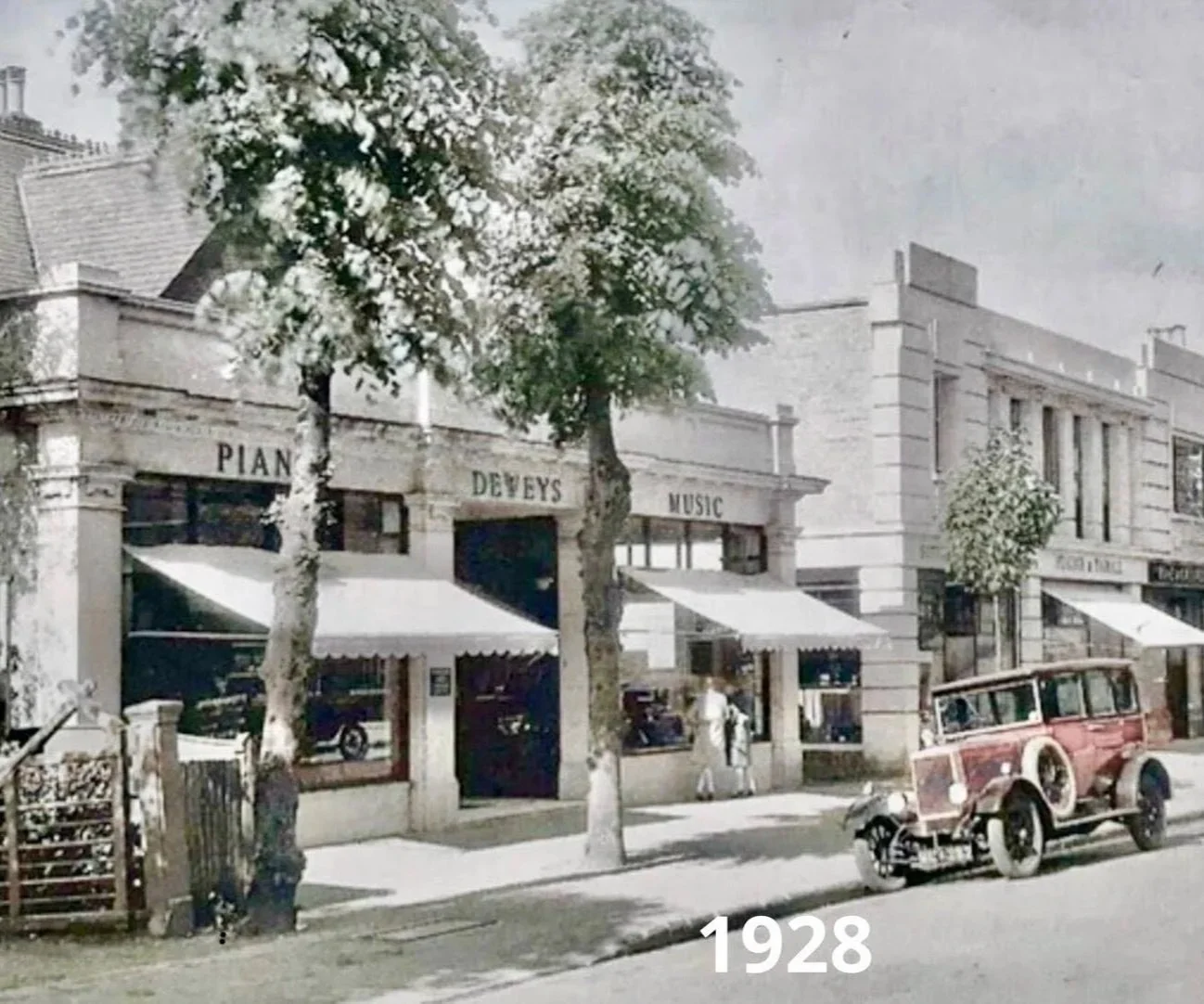
Grove - “a small wood or plantation of trees”
Pictured are the trees outside Deweys, the music shop Phil’s grandfather managed in Grove Road, Sutton, Surrey outside London. The trees were gone by the late 1950s - Phil’s earliest memories. But the shop, a department store of a kind, was still kicking goals, even if time was soon to be called on it too. There were musical instruments and sheet music as well as vinyl records with, in the window, a neon-lit Top 20 billboard, changed each week. And on the first floor, music tuition. Four lines of business, all related and all offering quality service, with lasting impacts for customers.
Publications
Research Papers
Estimating net benefits of high speed rail: How fit for purpose is Australia’s economic appraisal guidance?
Australasian Transport Research Forum, Auckland, November 2025
The paper identifies additions and changes to Australia’s transport economic appraisal guidance to enable more accurate assessment of the net benefits of high speed rail projects. These include: valuing travel time savings under mode switching and over distance; valuing capacity relief in affected modes; assessing inter-urban productivity impacts; valuing housing welfare impacts in newly ‘commutable’ locations; aligning the appraisal period with the investment length of life; adoption of a social rate of time preference discount rate-setting approach, replacing today’s social opportunity cost of capital conception; and improved alignment of project strategic and economic cases.
2025
What transport problems can high speed rail address and what opportunities can it enable? A route geography approach
Australasian Transport Research Forum, Melbourne, November 2024
The transport problems that high speed rail can solve and the opportunities (economic, social, environmental) it can enable in today’s legislated Brisbane-Sydney-Melbourne corridor vary according to four distinct route geographies, the paper contends. The route geographies are: major capital city to major capital – the longest, largely air-reliant; major capital to the end point of frequent but slow rail service: major capital to between that end point and up to 350 kilometres - less frequent rail service and in the aviation rain shadow; and major capital to 350-450 kilometres distant, where air service is available, but is more costly and less frequent than on routes between major capitals.
2024
What policy rationales can underpin high speed, fast and improved passenger rail in Australia?
Winner John H Taplin Prize for Best Paper, Australasian Transport Research Forum, Perth, November 2023
Six ‘candidate’ policy rationales that may support and sustain investment over time in different forms of upgraded long distance passenger rail are explored, in the context of the improvement in travel time, journey quality and journey affordability that upgrades might offer. These are: building better business productivity; population growth rebalancing; supporting near capital city regional centres that sit under the ‘aviation rain shadow’; future-proofing convenient intercity access to the centres of major capitals; assisting net zero emission transport; and a better integrated national rail network.
2023
Beyond the inner ring: air, coach and train services to regional centres further from state capitals
Australasian Transport Research Forum, Adelaide, September 2022
Drawing on service information supported by interviews with regional councils, the paper examines the adequacy of long distance public transport – and the car option – for centres located 200 kilometres or more from state capital cities. Distance bands are developed of: 200 to 350 kilometres, where most centres have neither air nor other fast public transport, but distances are driveable for other than day return/short stay business purposes; 350 to 1000 kilometres, where air service is costly but available and distances are driveable for some trip purposes; and above 1000 kilometres, where air fares are highest and distances are less driveable in other than recreational contexts.
2022
Australia’s long distance train and coach services: international comparisons
Australasian Transport Research Forum, Brisbane, December 2021
Using a set of service indicators, Australia’s long distance passenger train and coach services are compared with those of 11 countries that are ‘similar’ in having either large land area, high per capita income, or both. Comparison countries also do not have a high speed rail network.
2021
Profiling Australia’s interstate passenger train, coach and ferry services
Australasian Transport Research Forum, Canberra, September 2019
The paper profiles non-air public transport services on 35 interstate corridors. The service indicators used are route (road distance), weekly return services, intermediate stops per 100 kilometres, average end to end service speeds and average fare per 100 kilometres. Patronage information, where available, is also included.
2019
Australian shipping policy: what drives or constrains success?
Australasian Transport Research Forum, Melbourne, November 2016
Two areas of Australian shipping policy, liner regulation and Tasmania freight equalisation, have achieved solid outcomes over decades, with support across the political spectrum for the higher level objectives of, respectively, economic growth through trade and federal fiscal equalisation. Since the 1990s, in the absence of clear or accepted policy objectives for Australia’s coastal and international shipping industries, outcomes have been less satisfactory.
2016
30 years of Australian transport policy: what makes for success?
Australasian Transport Research Forum, Perth, September 2012
This paper examines Australian transport policy effectiveness in aviation and airports, the road network, road safety, road freight, rail freight and urban public transport, referencing available indicators of growth and productivity. With the length of time needed to achieve and maintain outcomes and transport’s ‘derived demand’ character, policy success is found to be linked to articulation and acceptance of a higher level non-transport policy goal, eg the economy or public health.
2012
Submissions
Submission on the Aviation Green Paper
November 2023
Responding to questions raised in the Green Paper, the submission noted the importance of distinguishing high traffic air routes to major regional tourism centres from the bulk of capital city-regional centre routes and the relevance to airline competition outcomes on any route of other transport modes and distance from a capital city. The submission included tables on: air and other mode services for regional centres between 100 and 350 kilometres from a capital city; regional air fares and the average number of air operators per route by distance band (200-349 km, 350-999 km, 1000 km and above); and domestic passenger load factors for different air route types.
2023
Submissions to the House of Representatives Standing Committee on Infrastructure, Transport and Cities inquiry into options for financing faster rail (Nos 27 and 27.1)
December 2019 and July 2020, Phil and Anthony
The first submission identified some key economic benefits of faster rail projects. On the premise that sole private funding of faster rail projects may be unlikely other than where a private party also has ownership of adjoining land for development, it recommended additions to the Australian Transport Planning and Assessment guidelines to better accommodate these benefits. An appendix provided service statistics (frequencies, service times and speeds by mode) for regional centres within a radius of 400 kilometres of each of Australia’s eight capital cities.
A supplementary submission, drafted after giving evidence at hearings, outlined approaches that could be applied to capturing land value gains on privately held land, or are otherwise helpful for part-funding faster rail infrastructure: betterment levies; voluntary beneficiary contributions; local rates supplements; ‘rail plus property’ development; and development impact fees for the cost of new infrastructure and services that result from the increased rail demand.
2019
Productivity Commission inquiry into the regulation of Australian Agriculture – draft report
July 2016
The submission provided information on efficiency improvement in the Australian shipping industry, compared to the 1980s and 1990s. It argued that, in addition to policy objectives for Australian shipping policy acknowledged in the commission’s draft report of cost-competitiveness for shippers and regulatory simplicity and certainty, a third objective is important to ensure the domestic industry’s future: an internationally competitive taxation regime for both ship owners and seafarers.
2016
Journalism
A high speed rail network will unlock economic opportunities
Australian High Speed Rail Association website (blog), 21 March 2024
2024
Fast rail and high speed rail solve different problems for Australia’s regions
Canberra Times, 16 July 2020, with Anthony Ockwell
The case for fast rail from Canberra to Sydney
Canberra Times, 7 May 2020, with Anthony Ockwell
2020
2020
It’s time to renovate Australian shipping policy
Sydney Morning Herald, 8 November 2016
2016
Low density is no barrier to public transport
Canberra Times, 20 August 2015
2015